
Complete Guide to Choosing the Right Commercial Dishwasher with Carrousel


Investing in a commercial dishwasher goes far beyond comparing spec sheets. It’s a strategic decision that directly impacts your productivity, operating costs, sanitary compliance and increasingly, your environmental footprint.
With the support of Emballages Carrousel, you can structure your decision in a smart, practical way, aligned with the day-to-day realities of your operation.
Here’s how to make the right choice without oversizing or underestimating your needs.
Start with the right assessment: volume and service pace
Before even looking at models, ask yourself a simple question: how many racks per hour do you actually need to wash during peak periods?
- Small café, bakery, grab-and-go counter: moderate flow, spaced-out cycles
- Restaurant with dining room: intense peaks concentrated at specific times
- Caterer, cafeteria, institutional kitchen: steady, continuous throughput
An undersized unit will slow your team down. An oversized one will unnecessarily increase your energy and water costs. The goal is to match the machine’s real capacity to your service pace.
Choosing the right type of commercial dishwasher
Undercounter dishwasher
Compact and efficient, it is well suited for limited spaces and low- to medium-volume operations. Ideal for coffee shops, bars, and small kitchens with space constraints.
Key advantage: easy integration under a countertop.
Watch out for: more limited capacity during peak periods.


Pass-through dishwasher
The most common choice in foodservice. Ergonomic loading, high throughput, and smoother workflow between dirty and clean zones.
Key advantage: increased productivity during peak hours.
Ideal for: restaurants with continuous service, caterers, and well-structured commercial kitchens.


Conveyor dishwasher
Designed for high-volume operations and continuous washing.
Key advantage: maximum hourly capacity.
Ideal for: institutional kitchens, food production facilities, and large-scale events.


Technical criteria that truly make a difference
Water and energy consumption
Modern commercial dishwashers use significantly less water than even a well-managed manual washing process. Optimizing these parameters helps reduce operating costs while also lowering your environmental footprint.
Some machines now feature smart cycles that automatically adjust wash time and temperature based on the actual load.
Temperature and sanitary compliance
In foodservice, sanitation is non-negotiable. High-temperature dishwashers ensure thermal disinfection that meets health standards, while reducing the need for excessive chemical use.
A key consideration for regulated or institutional environments.
Chemicals and dispensing system
A dishwasher’s performance doesn’t rely on the machine alone—it also depends on the products used and how accurately they are dosed.
An automatic dispensing system allows you to:
- ensure precise and consistent dosing of detergents and rinse aids
- avoid overdosing (unnecessary costs) or underdosing (ineffective cleaning)
- maintain consistent wash quality, regardless of the operator
It’s also a key lever to:
- optimize chemical consumption
- improve results (shine, no residue)
- reduce environmental impact
Ideally, opt for an integrated solution where the machine, chemicals, and dispensing system work together—with adjustments based on water quality and the type of ware being washed.
Discover our wide selection of cleaning products tailored to your needs, based on your water quality!
Ergonomics and noise
Technical service
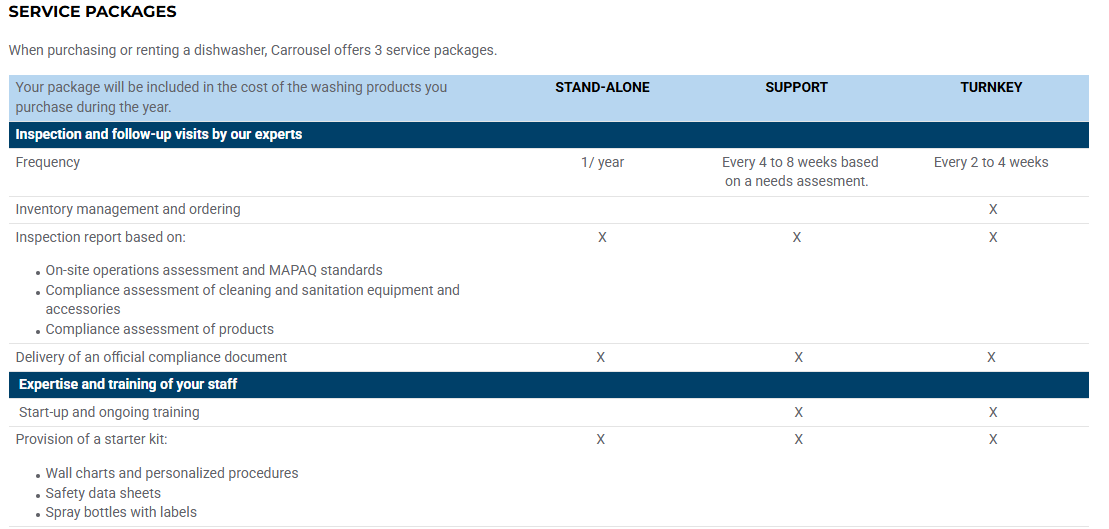
A commercial dishwasher is a critical piece of equipment—when it goes down, your entire operation slows down. That’s why technical service should be a core part of your decision, just like the machine’s performance.
Strong support includes:
- proper installation from the start (electrical, plumbing, calibration)
- fast response in case of breakdowns to avoid prolonged downtime
- a preventive maintenance program to extend the equipment’s lifespan
With Emballages Carrousel, we offer three service plans tailored to your day-to-day operational needs.
Two types of next-generation commercial dishwashers
Quelles différences existe-t-il entre les lave-vaisselles à basse température et à haute température ?
Think performance and environmental impact
Why choose Emballages Carrousel?
Beyond the equipment itself, Emballages Carrousel supports foodservice businesses with:
- an in-depth analysis of operational needs
- solutions tailored to real volume requirements
- compatible, optimized cleaning products
- guidance on integrating with your reusable dishware strategy
The advantage isn’t just technical, it’s strategic. You align equipment, consumables, and environmental goals with a single, trusted partner.
Key questions to ask yourself:
- What is my peak volume during busy periods?
- Does my space allow for a smooth workflow between dirty and clean zones?
- What is the hardness level of my water?
- Is my objective purely operational, or also environmental?
- Am I planning to increase the use of reusable dishware?
Conclusion
Choosing a commercial dishwasher means optimizing far more than just a washing station. It’s about securing your service rhythm, controlling operating costs, and supporting your sustainability commitments.
With a structured approach and the support of Carrousel, your investment becomes coherent, cost-effective, and aligned with the evolving foodservice industry.